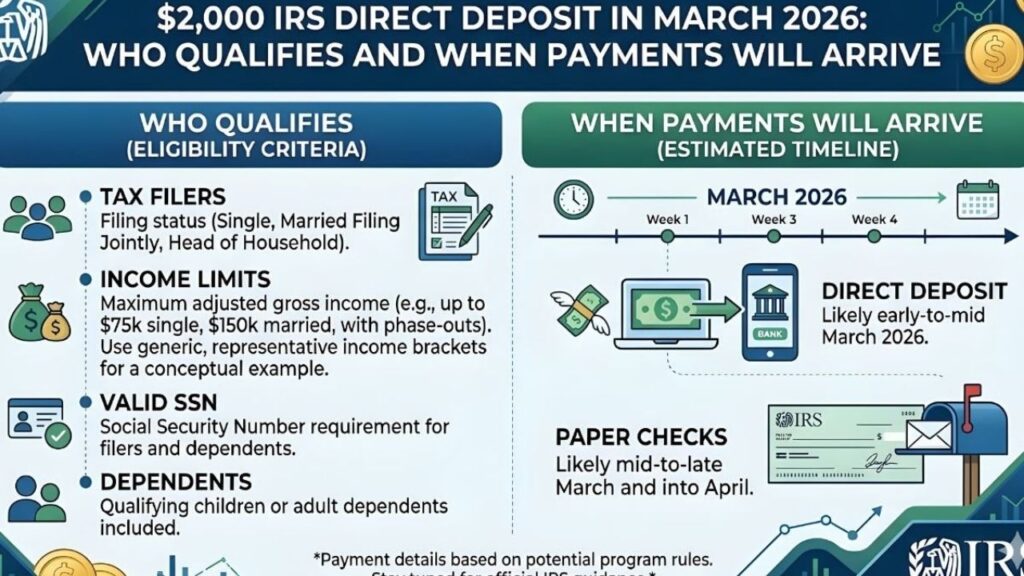

In recent weeks, conversations about a possible $2,000 direct deposit from the federal government have gained attention across social media and financial forums. Many Americans have seen posts suggesting that a payment of around $2,000 could arrive in March 2026. These discussions have raised hopes for some households while also creating confusion about whether such a payment is real.
The spread of such claims often happens during tax season, when millions of taxpayers are waiting for their refunds. During this period, people naturally search for updates about possible payments, tax benefits, or financial relief programs. As a result, rumors and incomplete information can circulate quickly online.
Financial experts and tax professionals say that the discussions about a $2,000 payment are likely connected to tax refunds rather than a new government stimulus program. Understanding the difference between these two types of payments is important for taxpayers who want accurate information about their finances.

Why tax season often creates payment confusion
Tax season is a busy period for both taxpayers and the Internal Revenue Service. Each year, individuals and families file their income tax returns to report earnings and calculate whether they owe taxes or are entitled to a refund.
Because tax refunds often involve direct deposits into bank accounts, some people mistakenly assume these payments are new government aid programs. This misunderstanding can easily spread online, especially when refund amounts vary from person to person.
For example, some taxpayers may receive refunds close to $2,000 or even higher depending on their income, withholding amounts, and eligibility for tax credits. When people share these experiences publicly, others may assume that a fixed government payment is being issued to everyone.
Latest Stories
 Up to $2,000 IRS Tax Refund in March 2026, What Millions of Americans Need to Know Before Filing
In reality, tax refunds are highly personalized. The amount each taxpayer receives depends on their individual tax return and financial situation.
Tax Refunds, Not Stimulus Payments
It is crucial to clarify that there has been no nationwide announcement of a $2,000 stimulus payment set for March 2026. Instead, many taxpayers are likely to receive deposits around this amount as part of their federal tax refunds. These refunds are issued after the IRS processes tax returns, and the amount each taxpayer receives is based on their individual tax situation.
Understanding the difference between refunds and stimulus payments
Stimulus payments and tax refunds are two completely different types of government payments, although both can appear as direct deposits in bank accounts.
Latest Stories
 IRS Tax Refund 2026: How to Track Your Payment, Expected Timelines and What to Do if Your Refund Is Delayed
Stimulus payments are special financial assistance programs created by the government during economic crises. These payments are usually announced through official legislation and are distributed to eligible citizens based on specific criteria.
Tax refunds, however, are a regular part of the annual tax filing process. When individuals pay more in federal taxes during the year than they actually owe, the IRS returns the extra amount.
Because tax refunds are based on individual financial details, the payment amount can vary widely. Some people may receive small refunds, while others may receive several thousand dollars depending on their tax situation.
How tax refunds are determined
Every tax refund begins with a simple calculation: the total tax paid during the year compared to the total tax owed.
Throughout the year, employers withhold federal income taxes from employee paychecks. These payments are sent to the government as advance tax contributions.
When taxpayers file their annual returns, the IRS calculates the exact amount of tax owed based on income, deductions, and credits. If the taxpayer paid more than required, the difference becomes a refund.
This process explains why some refunds can reach $2,000 or more. It simply means that the taxpayer paid more tax during the year than necessary.
How Tax Refunds Are Calculated
The calculation of tax refunds depends on several factors, including a taxpayer’s income, tax withholding, and eligibility for certain credits. When individuals pay more in federal taxes throughout the year than they owe, the surplus is refunded to them. Tax credits, such as the Earned Income Tax Credit or the Child Tax Credit, can significantly increase the total refund for eligible taxpayers. Each refund amount is individually determined based on the information provided in the tax return, and the amount can vary widely from one person to another.
The role of tax credits in boosting refunds
Tax credits play an important role in determining the final refund amount. Unlike deductions, which only reduce taxable income, tax credits directly reduce the amount of tax owed.
One of the most important credits for working families is the Earned Income Tax Credit. This credit is designed to support low- and moderate-income workers by reducing their tax burden.
Another major benefit is the Child Tax Credit, which provides financial support to families with qualifying children. In many cases, these credits can create a refund even if the taxpayer owes little or no federal tax.
When these credits are combined with normal tax calculations, they can significantly increase the final refund amount.
Why some refunds reach $2,000 or more
Several situations can result in refunds around $2,000 or higher. One common scenario occurs when a taxpayer has a steady income with consistent withholding throughout the year.
If the withholding amount is higher than the final tax liability, the IRS will refund the difference.
Another situation involves families who qualify for multiple tax credits. For example, a household with two or more children may benefit from both the Earned Income Tax Credit and the Child Tax Credit.
These combined benefits can create substantial refunds, which is why some taxpayers see deposits close to $2,000 during tax season.
Filing Methods and Timing
The method and timing of filing can impact when taxpayers receive their refunds. Individuals who file electronically and opt for direct deposit typically receive their refunds much faster than those who submit paper returns. The IRS usually processes electronic returns within 10 to 21 days. Early filers in the 2026 tax season might see their payments in early or mid-March, while those who file later could receive their deposits toward the end of March or early April. Paper filings generally take longer due to the need for manual processing.
The advantage of electronic filing
Electronic filing has become the most popular way to submit tax returns in the United States. The IRS e-file system allows taxpayers to submit returns quickly and securely through online platforms.
E-filing also reduces the chance of errors because most tax software programs automatically check calculations and missing information before submission.
When a return is submitted electronically, it enters the IRS processing system immediately. This can significantly speed up the review and approval process.
Because of these advantages, the IRS strongly encourages taxpayers to file electronically whenever possible.
Direct deposit versus mailed checks
Once the IRS approves a refund, the payment must be delivered to the taxpayer. The two main options are direct deposit and paper checks.
Direct deposit is widely considered the fastest and safest option. The money is transferred directly into the taxpayer’s bank account without the need for postal delivery.
Paper checks, on the other hand, must be printed and mailed, which can add extra days or even weeks to the waiting period.
As a result, many taxpayers choose direct deposit to receive their refunds faster.
Avoiding Delays and Scams
To avoid delays in receiving refunds, taxpayers should ensure they file their returns electronically and verify that their banking information is accurate before submission. Choosing direct deposit over a mailed check can also expedite the refund process. It is important for taxpayers to be vigilant during tax season, as scammers often circulate misleading claims about government payments. The IRS never sends unsolicited messages requesting personal or banking information to release refunds. Taxpayers should always confirm payment information through official IRS communication channels and avoid engaging with suspicious messages.
Recognizing tax season scams
Tax season often attracts scammers who attempt to take advantage of taxpayers waiting for refunds. These scammers may send fake emails, text messages, or phone calls claiming to represent the IRS.
In many cases, they promise faster refunds or special payments in exchange for personal information.
The IRS has repeatedly warned taxpayers that it does not contact individuals through unsolicited messages to request sensitive financial details.
Anyone who receives such messages should ignore them and report the activity through official IRS channels.
How taxpayers can safely track refunds
To check the status of a refund safely, taxpayers should rely on official IRS tools. One of the most widely used tools is the “Where’s My Refund?” feature available on the IRS website.
This system allows taxpayers to see whether their return has been received, approved, or sent for payment.
The tool usually updates once every 24 hours, providing reliable information about the refund timeline.
By using official resources instead of relying on online rumors, taxpayers can stay informed and avoid unnecessary confusion during the tax season.
FAQs
1. Is the $2,000 direct deposit in March 2026 a stimulus payment?
No, there has been no official announcement of a new $2,000 stimulus payment. Most deposits around this amount are likely tax refunds.
2. Why are some taxpayers receiving refunds close to $2,000?
Refund amounts depend on tax withholding, income level, and eligibility for credits such as the Earned Income Tax Credit or Child Tax Credit.
3. How long does it take to receive a tax refund from the IRS?
Most electronic filers who choose direct deposit receive their refunds within 10 to 21 days after their return is accepted.
4. How can I track my IRS refund?
You can check your refund status using the official “Where’s My Refund?” tool on the IRS website.
5. How can taxpayers avoid tax season scams?
Taxpayers should avoid responding to unsolicited emails or messages claiming to be from the IRS and always verify information through official IRS channels.